Introduction: Why Now Is the Time for Smart Dubai Property Research
Dubai’s real estate market is making headlines again. In 2026, the city continues to attract global investors with impressive transaction volumes and steady price growth. According to a recent report on the Dubai property market softening in early 2026, residential capital values stayed up 8.9% year on year.
The market is still strong, even as the pace of growth slows down.
For many investors, the biggest hurdle isn’t finding properties in Dubai for investment. It’s making sense of all the information out there.

You might know that properties prices in Dubai look promising, but how do you separate hype from real data? How do you navigate legal rules, find trustworthy developers, and calculate your true return on investment? These questions can feel overwhelming, especially if you are investing from overseas.
That is where smart dubai property research makes all the difference. This guide uses data-driven insights and expert analysis to help you make informed decisions about your investment in Dubai properties. We cover location comparisons, developer track records, hidden costs, and rental yield projections. Whether you are a first time buyer or a seasoned investor, knowing how to research properly is your biggest advantage.
If you are just getting started, our complete guide to buying real estate in Dubai walks you through everything from market analysis to closing the deal.
Ready to move from research to action? Book a FREE Dubai Real Estate Consultation with Ayaz Salman and get personalized guidance for your investment goals.
Why Dubai Property Remains a Top Investment Destination in 2026
So what makes Dubai stand out from other global cities? Let’s break it down simply.
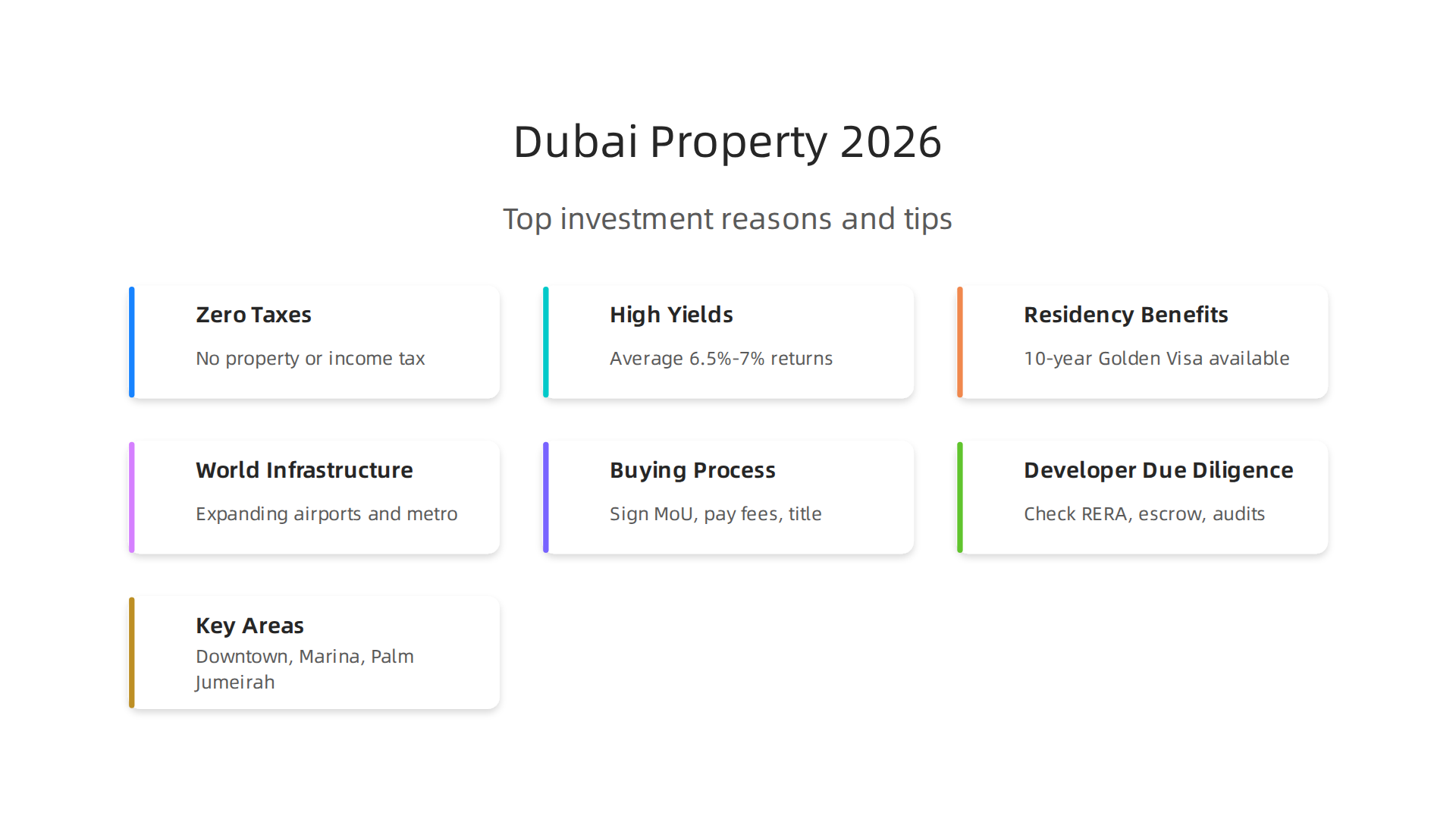
First, the tax advantage is a game changer. You pay zero property tax, zero capital gains tax, and zero income tax on rental earnings. Compare that to London where stamp duty alone can eat up to 12% of your purchase price. In New York, property taxes run around 1-2% of the home value every single year. Singapore charges hefty stamp duties and additional buyer taxes. Dubai gives you 100% of your returns with nothing taken off the top.
Second, the rental yields speak for themselves. The average gross rental yield in Dubai sits between 6.5% and 7% citywide, according to a market analysis of the Dubai real estate market 2026.
Some areas like Jumeirah Village Triangle push past 8.5%. In central London, yields hover around 3%. New York gives you about 4% on a good day. Singapore landlords often settle for 2-3%. That difference matters when you are growing your portfolio.
Third, the residency benefits are real. You can secure a 10-year golden visa by investing in a property worth at least AED 2 million. Recent policy changes in 2026 have made it even easier to qualify. The government also lifted the old requirement of having a local partner for certain business setups. Foreign investors now enjoy 100% ownership across most sectors. These moves show the UAE is serious about keeping its market open and attractive.
Fourth, the infrastructure is world class and still expanding. The new Al Maktoum International Airport, the expanded Dubai Metro, and the upcoming Expo City Dubai district all drive demand. This means your investment in properties in Dubai for investment benefits from both current demand and future growth.
With all these advantages, smart investors are paying close attention. If you want to learn how to take advantage of these conditions, check out this guide on how to invest in off-plan properties in Dubai for maximum returns. That type of investment can lock in today’s prices while the market grows around you.
The combination of zero taxes, high yields, clear residency paths, and constant development makes Dubai one of the most attractive places for investment in Dubai properties in 2026. The next step is knowing exactly where to put your money and how to research it properly.
Current Market Prices & Trends: A Data-Driven Overview
Now that you understand why Dubai stands out, let’s look at the numbers. Your dubai property research should start with real data, not guesses.

Here is what the market looked like in 2026.
Average Price per Square Foot in Key Communities
Prices vary a lot depending on where you buy. Here is a snapshot of average transaction prices per square foot in the first half of 2026:
| Community | Average Price per Sq Ft (AED) | Property Type |
|---|---|---|
| Downtown Dubai | 2,800 – 3,200 | Luxury apartments |
| Dubai Marina | 2,200 – 2,600 | Waterfront apartments |
| Palm Jumeirah | 3,500 – 4,000 | Villas and apartments |
| Jumeirah Village Circle (JVC) | 1,300 – 1,500 | Mid-range apartments/townhouses |
| Dubai South | 900 – 1,200 | Affordable apartments/villas |
The citywide average for off-plan homes hit AED 2,030 per sq ft in Q1 2026, according to the United Arab Emirates’ Residential Property Market Analysis 2026.
That was up 12.22% year-on-year. For ready properties, the REIDIN index showed a 15.60% annual increase.
Year-on-Year Price Changes (2024–2026)
The market has cooled slightly from the 2024–2025 boom but remains strong. According to ValuStrat, residential capital values still rose 8.9% year-on-year in Q1 2026. The Dubai property market softens in early 2026 as fundamentals stay intact report confirms the slowdown is mild. Overall, price appreciation is expected to moderate to 5% to 8% in 2026, down from the 12% to 22% growth seen in 2024 and 2025.
Despite the moderation, transaction volumes hit record highs. In H1 2026, Dubai recorded 79,281 residential sales worth AED 221.4 billion, as noted in the Dubai Housing Market 2026: Mid-Year Review & Outlook. That shows demand is still very real.
Emerging Affordable Luxury Areas
If you are doing your dubai property research and want high appreciation potential without paying premium prices, look at these up-and-coming neighborhoods. The Up-and-Coming Areas in Dubai for Property Investment in 2026 report highlights five areas: Palm Jebel Ali, Emaar Beachfront, The Oasis, Dubai South, and Dubai Islands. These zones benefit from new infrastructure like Etihad Rail and the Al Maktoum International Airport expansion.
Affordable luxury is especially strong in Dubai South and JVC. You can enter these communities at lower prices per square foot while still getting good rental yields and steady capital appreciation.
If you want personalized help analyzing these numbers and finding the right property for your goals, reach out for a FREE Dubai Real Estate Consultation. A quick chat can save you hours of digging through spreadsheets.
Once you have the price data clear, the next step is understanding how financing works. That is exactly what we cover next.
High Rental Yields: Understanding the ROI Potential
Before we get into financing, let’s talk about what most investors really want to know first: how much money can this property make me? Rental yields are a huge part of your dubai property research because they tell you the real earning power of your investment.
Typical Rental Yields in Dubai
Dubai is famous for high rental returns. Citywide gross rental yields average around 6.5% to 7% in 2026, according to the Dubai real estate market 2026: Rental yields, prices & what’s next report. Some areas do even better. For example, Jumeirah Village Circle (JVC) offers yields around 6.5% for one-bedroom apartments, while International City can deliver up to 9.1% and Silicon Oasis around 7.7%, as shared in a community data analysis of gross rental yields across Dubai apartments.
Your actual yield depends on the property type too. Studios typically bring in higher returns than larger units. The Top rental yields in Dubai 2025 report shows studio yields at 8.42%, while one-bedroom apartments sit around 5.83% and two-bedrooms at 5.17%. So if pure yield is your goal, smaller units often win.
How Dubai Compares to Other Major Cities
Here is where Dubai really shines. In cities like London, New York, or Singapore, gross rental yields usually fall between 2% and 4%. So Dubai’s 6% to 7% average is roughly double what you would get in those mature markets. Plus, Dubai charges zero income tax on rental earnings. That means you keep every dirham of rent you collect. That is a huge advantage for anyone looking at investment in dubai properties to build passive income.
What Affects Your Rental Yield
Several factors can push your yield up or down:
- Location: Prime areas like Palm Jumeirah or Downtown Dubai have lower yields (around 4% to 5%) because purchase prices are very high. Up-and-coming neighborhoods like Dubai South or JVC offer higher yields because entry prices are lower.
- Property type: Studios and one-bedroom apartments tend to yield more than three-bedroom villas. There is always strong demand for affordable rentals.
- Furnished vs unfurnished: Furnished units often command higher monthly rent, which can boost your gross yield by 1% to 2% in popular areas.
- Seasonal demand: Dubai’s winter tourism spike means short-term rentals can earn more during peak months, though they also come with higher management costs.
Understanding these variables helps you pick the right unit for your goals. If you want to explore how buying off-plan can boost both yield and appreciation, check out this guide on how to earn 8% yields through Dubai property investment.
Once you have a clear picture of rental returns, you can move on to financing and see how leverage can multiply your returns even further. That is next.
Legal Framework for Foreign Buyers: Freehold vs Leasehold
Knowing your potential rental returns gets you excited. But before you sign any deal, there is one piece of dubai property research you cannot skip: understanding the legal rules for foreign buyers. This framework shapes everything from where you can buy to how you secure residency.
Dubai makes it easy for foreigners to buy property, but only in certain areas. These are called freehold zones. There are over 60 designated freehold zones where you can own the land and the building 100%. You can sell it, rent it out, or pass it down to your family. It is yours. Popular freehold communities include Dubai Marina, Downtown Dubai, Palm Jumeirah, and Jumeirah Village Circle. According to the resource on Where Can Foreigners Buy Property in Dubai in 2026?, no prior residency or local sponsorship is needed to buy in these zones. In other parts of Dubai, foreigners may only get leasehold rights, usually for 99 years. For most investors looking at properties in dubai for investment, freehold is the best choice.
Once you pick a property, the buying process follows a clear path.
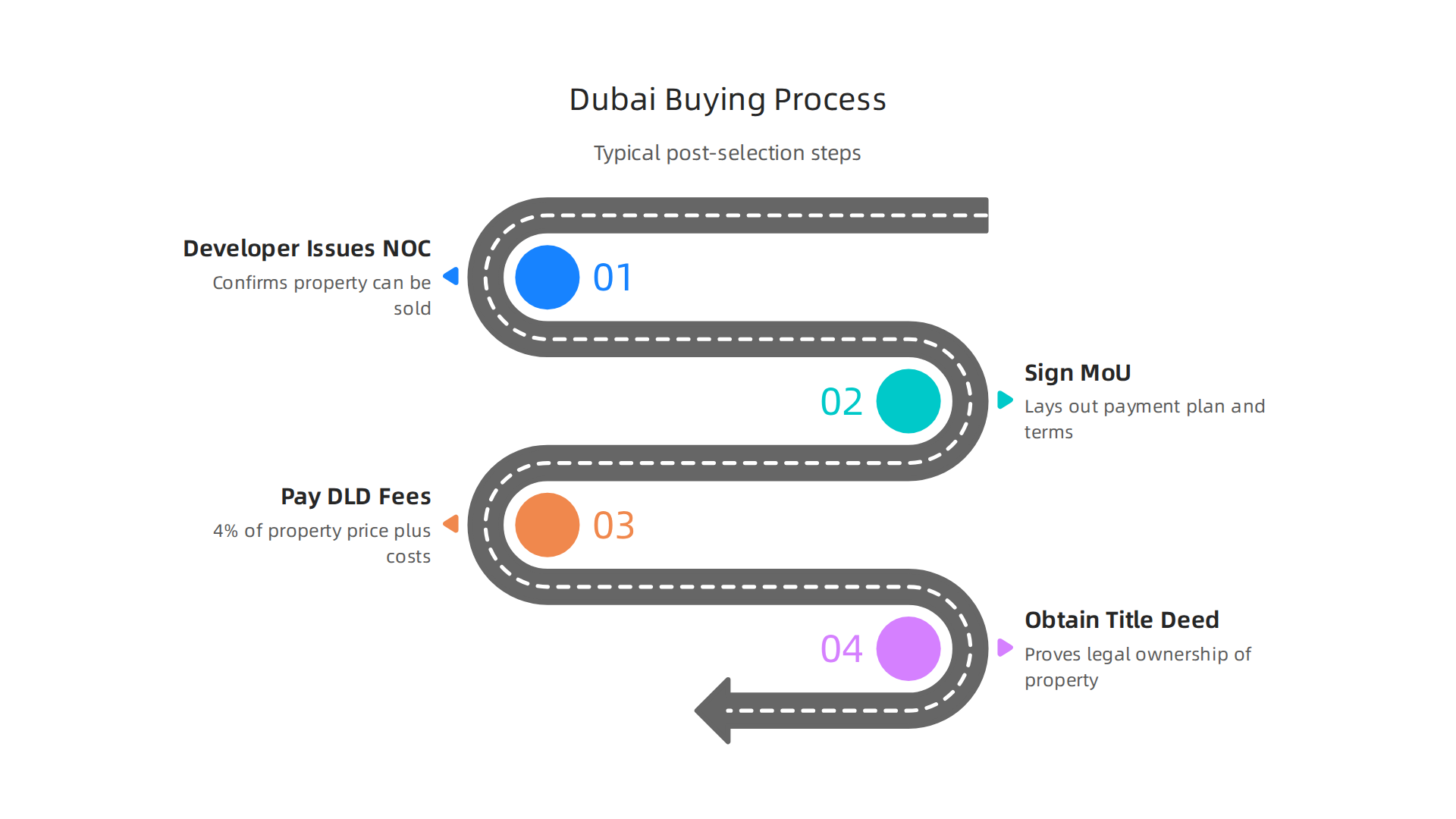
It usually takes a few weeks to close a deal. First, the developer issues a No Objection Certificate (NOC). This confirms the property can be sold. Then you and the seller sign a Memorandum of Understanding (MoU), which lays out the payment plan and terms. After that, you pay the Dubai Land Department (DLD) fees. This is normally 4% of the property price plus some small admin costs. The final step is getting your title deed. That piece of paper proves legal ownership. No hidden surprises if you know the steps ahead of time. If you want a full walkthrough of every stage, check out this guide on how to buy property in Dubai in 2026.
Here is one of the biggest perks of buying property in Dubai. Ownership can open the door to residency. If your property is worth at least AED 750,000, you can apply for a 2-year renewable investor visa. This is a huge plus for anyone making an investment in dubai properties from abroad. If you invest AED 2 million or more, you qualify for the 10-year Golden Visa. This gives you long-term stability and the freedom to live and work in the UAE. Getting the right property that also unlocks residency takes expert guidance. You can explore the Top Freehold Areas in Dubai: Hotspots for Property Investment to see which neighborhoods match your goals. Then, for a personalized walkthrough, connect with Ayaz Salman for a FREE Dubai Real Estate Consultation.
Tax Advantages & Cost Comparison with Global Markets
Now here is where Dubai really separates itself from almost every other market in the world. The tax benefits are not a small perk. They are the main reason so many international investors make Dubai their first choice for properties in dubai for investment.
Let us start with the big three numbers: zero, zero, and zero.
Dubai charges zero percent property income tax. Every dirham of rent you collect is yours to keep. There is zero capital gains tax when you sell. If your property doubles in value over ten years, you walk away with every single dollar of that profit. And there is zero inheritance tax. You can pass the property to your children without the government taking a cut. This is a game changer for anyone building generational wealth.
Now let us talk about the actual costs you will pay. The biggest upfront fee is the 4% transfer fee paid to the Dubai Land Department. On a AED 1 million property, that is AED 40,000. You also pay a standard agency fee, usually 2% of the purchase price plus VAT. Small registration fees add maybe a few thousand dirhams. Annual costs include a modest municipality fee (roughly 2.5% of your annual rent value) and maintenance for the building. Compared to what you pay elsewhere, these fees are incredibly low.
To see how this stacks up, look at the numbers side by side with other global markets. If you buy a property in the UK today, you face stamp duty land tax that can reach 5% to 15% depending on the price. When you sell, you pay capital gains tax up to 28% on the profit. The US hits you with annual property taxes ranging from 0.5% to over 2% of the home value every single year. Some states add income tax on rental earnings too. Mainland Europe brings its own mix of wealth taxes, notary fees often exceeding 10%, and inheritance taxes that can take 20% to 40% of your legacy.
Dubai’s total holding cost is a fraction of what you pay in these markets. And because there are no recurring annual property taxes, your net return stays high year after year. This is why property values in Dubai continue to rise while rental income flows tax-free into your pocket.
If you want a full breakdown of the buying process including all fees, check out this guide on buying real estate in Dubai a step by step guide for smart investors. It walks you through every cost so nothing surprises you at closing.
The tax advantage alone makes Dubai one of the most investor-friendly markets in the world for 2026. And when you combine that with the actual costs of buying and holding property, the financial case becomes very hard to ignore.
Top Areas for Investment: Where to Buy in 2026
Now that you understand the tax advantages and costs, the next question is where to put your money. Dubai is made up of dozens of distinct communities, each serving a different type of investor.
Doing proper dubai property research means matching the area to your goal.
Let us break it down by three common goals: high rental yield, capital appreciation, and lifestyle purchase.
High rental yield areas are all about monthly cash flow. You want a low purchase price relative to the rent you can charge. Jumeirah Village Circle (JVC) is a top pick here. It offers affordable properties prices in dubai with rental yields often hitting 7% to 9%. Dubai South is another favorite thanks to its proximity to the Expo site and the new airport. Many off-plan projects here promise yields above 8%. Dubailand is the third heavy hitter, with entry prices under AED 800,000 for one-bedroom units and strong tenant demand from families.
Capital appreciation focuses on long-term value growth. Palm Jumeirah and Downtown Dubai have proven track records. Prices in these areas have climbed steadily year after year. Port de La Mer is a newer beachfront community by Meraas that has already seen strong price increases. If your goal is buying low now and selling for a profit later, these areas deserve your attention.
Lifestyle purchase means you plan to live in the property or use it as a vacation home. Emirates Hills offers villa living with gated community privacy. Arabian Ranches is perfect for families who want green space and a suburban feel. These areas may not give the highest yields, but they hold value well and offer a premium quality of life.
Here is a quick comparison of key communities to help with your research:
| Community | Avg Price per Sq Ft (AED) | Rental Yield | 1-Year Price Change |
|---|---|---|---|
| Jumeirah Village Circle (JVC) | 1,300 | 7.5% | +8% |
| Dubai South | 1,100 | 8.2% | +12% |
| Dubailand | 1,000 | 7.8% | +10% |
| Downtown Dubai | 2,200 | 5.5% | +6% |
| Palm Jumeirah | 3,500 | 4.8% | +5% |
| Port de La Mer | 2,500 | 5.2% | +9% |
| Emirates Hills | 2,800 | 4.0% | +4% |
| Arabian Ranches | 1,600 | 6.0% | +7% |
| Dubai Marina | 1,800 | 6.8% | +7% |
Upcoming areas with huge potential include Dubai Creek Harbour, Expo City, and Dubai South (already mentioned for yield). Dubai Creek Harbour is a massive waterfront development by Emaar that is still in its early stages. Prices are reasonable now, and once the Dubai Creek Tower and surrounding infrastructure are complete, experts expect serious appreciation. For a closer look at which off-plan projects are worth your time, check out this guide on how to invest in Dubai off-plan properties for maximum returns.
According to a recent market review, these up-and-coming areas in Dubai for 2026 are driven by new infrastructure like Etihad Rail and the expansion of Al Maktoum International Airport. That kind of government investment is a green light for long-term growth.
Picking the right area is the most important step in your investment in dubai properties. If you are not sure which community fits your budget and goals, do not guess.
FREE Dubai Real Estate Consultation — Get personalized advice from Ayaz Salman to match you with the perfect neighborhood.
How to Identify Reputable Developers and Projects
Picking the right neighborhood is only half the battle. Your dubai property research must also include a deep look at who is building your property. A great location means nothing if the developer delays the project or runs into money trouble. Here is how to tell the good developers from the risky ones.
Check RERA registration first. Every off-plan project in Dubai must be registered with the Real Estate Regulatory Authority (RERA). You can verify this through the Dubai REST app or the DLD website. If a project has no RERA number, walk away. The complete checklist for verifying a developer’s reputation is a must-read before signing anything.
Escrow accounts protect your money. Once you confirm RERA registration, make sure the project has a dedicated escrow account with a RERA-approved bank. Your payments must go only into that account, never to the developer directly. You can learn more about the full escrow account verification process to be certain your funds are safe. Escrow accounts ensure your money is used only for construction, not for the developer’s other projects.
Red flags to watch for. Unrealistic payment plans are a classic warning sign. If a developer offers 50% discount or zero commission deals that seem too good, ask why. Lack of transparency about project timelines, negative reviews from past buyers, or a history of delayed handovers are serious concerns. Check forums, social media groups, and the developer’s track record on previous projects.
Your due diligence checklist should include these steps:
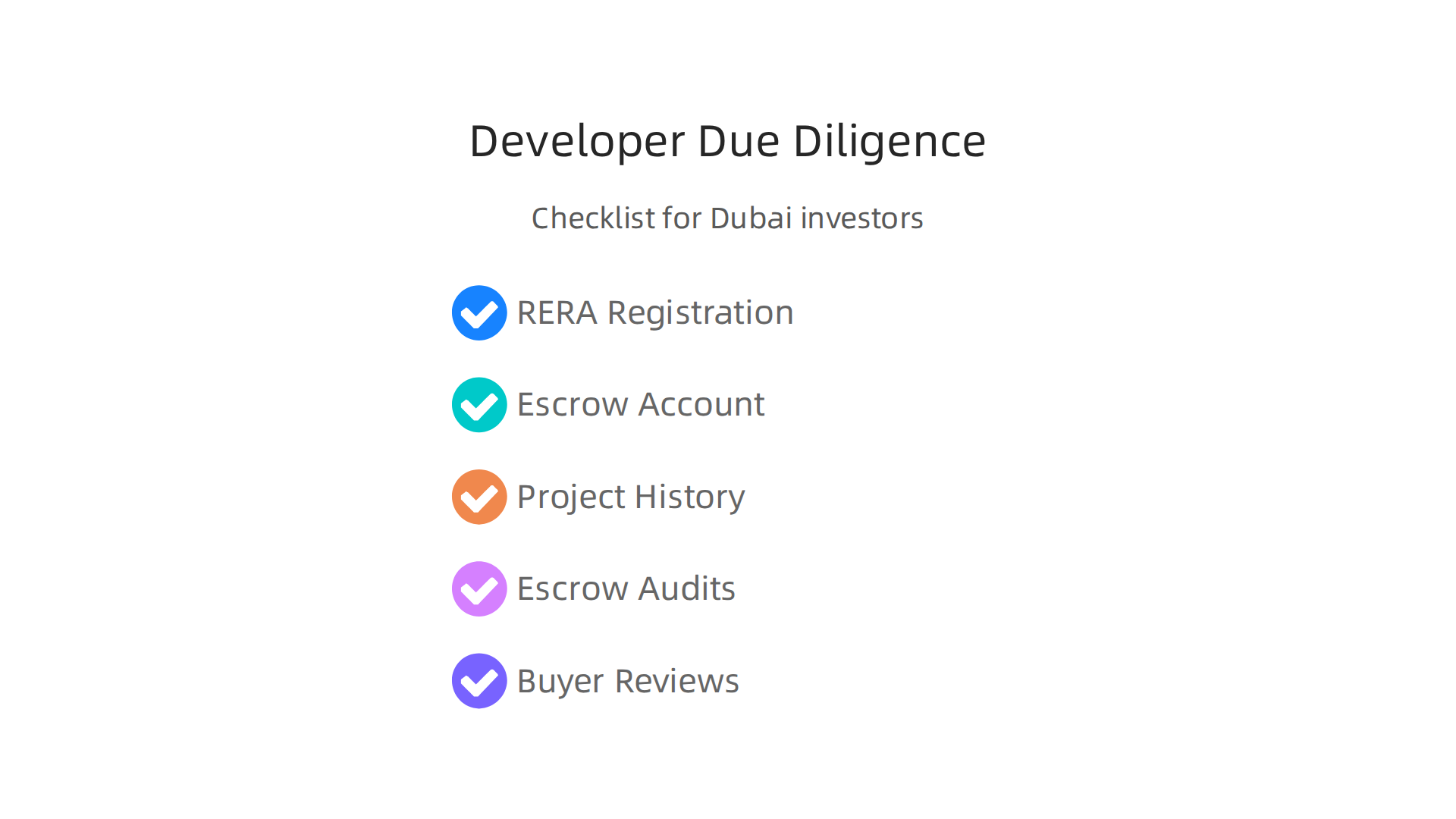
- Visit the RERA website and search the project registration number
- Confirm the escrow account number and that it matches your Sale Purchase Agreement
- Research the developer’s past project completion history
- Look for annual escrow account audits, which RERA requires for every active project
- Read buyer reviews and check for any legal disputes
By following this checklist, your investment in dubai properties becomes much safer. You reduce the risk of delays and protect your capital. If you want personal help vetting developers and finding the right project, do not guess alone.
FREE Dubai Real Estate Consultation — Get expert guidance from Ayaz Salman to identify trustworthy developers and secure your investment.
Managing Your Property from Abroad: Tips for Overseas Investors
If you live outside Dubai, managing a property from thousands of miles away might seem stressful. But the truth is, thousands of overseas investors do it every year without major headaches.

The secret is using professional help and setting up the right systems before you leave.
What property management companies cover. Most firms handle the whole rental lifecycle. They find and screen tenants, collect rent, handle maintenance requests, and deal with any legal issues that come up. They are your local team. According to the Understanding Property Management Fee Structure in Dubai, fees usually range from 5% to 10% of annual rental income. For short-term rentals, you might pay 15% to 25%, but the rent per night is much higher.
How to set up remote ownership. You need three things in place before you finalize your purchase. First, appoint a Power of Attorney. This is a legal document that lets someone you trust sign contracts for you. Second, open a UAE bank account. Many banks allow nonresidents to open accounts with just a passport and proof of address. Third, pick a RERA registered management company with strong reviews. You can follow a step by step framework for your property search to make sure you cover all the steps.
Common worries and how to fix them. Maintenance is a top concern. Good management companies do regular inspections and keep a list of approved contractors, so you are not chasing plumbers from abroad. Legal disputes are rare when you have a clear contract and RERA registration behind you. And while Dubai has zero income tax on rental earnings, your home country might still tax worldwide income. Keep records and talk to a tax professional to stay compliant.
With the right setup, your investment in dubai properties can run smoothly even when you are not there. You earn passive income without the daily work. That is the real benefit of owning property in a market built for global investors.
Summary
This guide explains how to do smart Dubai property research in 2026 so you can make data-driven investment decisions. It summarizes current price levels and trends across key communities, compares rental yields with major global cities, and shows where affordable-luxury and high-yield opportunities are emerging. The article also walks you through the legal framework for foreign buyers (freehold vs leasehold), the tax advantages and real holding costs, and a practical checklist for vetting developers and off‑plan projects. You will learn which areas suit yield versus capital growth goals, how to estimate realistic returns, and the steps to close a purchase and manage the property remotely. Read this to confidently narrow choices, avoid common red flags, and set up financing and management that protect your investment.