Introduction: Dubai’s Property Market in 2026 – Opportunities Amid Change
Thinking about buying property in Dubai in 2026? You are not alone.

The city’s real estate market has shown remarkable strength, drawing investors from around the world who want stable returns and a tax-free lifestyle.
Here’s a quick look at where things stand. According to the Dubai Real Estate Market Outlook 2026 from ValuStrat Research, citywide residential capital values are projected to grow by a sustainable 10% this year.

Villas are expected to lead the way with a 17.7% increase. That kind of steady growth is rare in global property markets right now.
But let’s be real. Even with all these opportunities, the process can feel overwhelming. Understanding uae property prices, learning the legal rules, and figuring out how to manage a property from overseas is a lot to handle. Many potential buyers get stuck because they don’t know where to start or who to trust.
That is exactly why this guide exists. We have put together data-driven insights to help you cut through the noise and make a smart choice about property uae investments. Whether you are looking at dubai real estate news to time your purchase or researching the abu dhabi real estate market for comparison, this article will give you the facts you need.
We will cover current price trends, what to expect from new supply, and how to invest in dubai real estate with confidence. For a deeper look at the full buying process, check out our step-by-step guide for smart investors on buying real estate in Dubai.
If you are ready to take the next step, get a FREE Dubai Real Estate Consultation with Ayaz Salman, a local expert who can help you navigate the market and find the right property for your goals.
Let’s dive in and explore what 2026 means for your real estate journey in Dubai.
UAE Property Price Trends and Forecasts for 2026
So what do the actual numbers look like for uae property prices right now? Let’s break it down in plain terms.

As of early 2026, the average residential property price in Dubai sits around AED 3.05 million, which is about $830,000. The median price is lower at around AED 2.1 million because luxury homes pull the average up. Most properties fall in a range of AED 900,000 to AED 5 million. For a deeper look at how these numbers compare by neighborhood, check out the full 2026 Dubai housing price report from Sands Of Wealth.
If you prefer to think in square footage, the median price per square foot is roughly AED 1,925. That equals about $524 per square foot. Compare that to luxury communities like Emirates Hills, where villas can cost around AED 14,500 per square foot. That is roughly 17 times more expensive than entry-level areas like Discovery Gardens.
Here is something that surprises many people. Prices have climbed about 10% to 13% year over year in 2026. That is well above the UAE’s low inflation rate. It means your purchasing power holds up better here than in many other markets.
Some of the most expensive and sought-after neighborhoods include Downtown Dubai, Palm Jumeirah, and Dubai Marina. These areas command premium prices because of location, views, and lifestyle. They also tend to hold value better during slower periods.
Forecasts from Moody’s suggest a moderate price correction could come in 2026 as tens of thousands of new units hit the market.

According to the Moody’s report on UAE home prices, about 150,000 new homes will be built across the UAE from 2025 to 2027, with roughly 120,000 units expected in Dubai alone this year. That new supply could put downward pressure on prices in some segments.
But here is the thing. Dubai has historically absorbed about 35,000 to 45,000 units per year. So not all of those planned units will actually get delivered on time. Plus, population inflow and economic diversification continue to support demand. The long-term picture still looks healthy.
If you want to understand which areas offer the best balance of price and growth potential, read our detailed guide on how to choose the best property developers in Dubai for high returns. Knowing where to focus your search makes a huge difference.
For now, the key takeaway is this. UAE property prices are still climbing at a sustainable pace, with villas outperforming apartments. Luxury districts hold their premium, while mid-range areas offer more affordable entry points. And with new supply coming, you may find better negotiation power later in the year.
Year-on-Year Price Movements in Key Dubai Areas
Not every neighborhood moves in lockstep. While the market overall is rising, some areas are speeding ahead faster than others. Take Jumeirah Village Circle (JVC) and Dubai South, for example. These communities have recorded stronger price gains because they offer more affordable entry points. Buyers priced out of premium districts are turning to these locations, pushing demand and values up.
Luxury segments tell a different story. Areas like Palm Jumeirah and Emirates Hills remain stable, but they have seen occasional price corrections as buyers pause and reassess. According to the ValuStrat Dubai Real Estate Market Outlook 2026, citywide residential capital values are projected to grow 10% this year, with villas expected to outperform apartments by appreciating 17.7%. That gap between villa and apartment performance shows up clearly in mid-range villa communities.
Looking back at 2025 data across the market, the trend was clear. Median apartment asking prices rose roughly 12% year over year, while villa prices climbed about 8%, with faster growth happening in more affordable neighborhoods. If you want to put your money where the momentum is, focus on value-driven districts rather than chasing already-priced luxury enclaves. For a side-by-side comparison of two top choices, read our guide on properties for sale in Downtown Dubai vs Dubai Marina for 2026 returns and lifestyle insights.
Still trying to decide which area fits your budget and goals? Book a free FREE Dubai Real Estate Consultation with Ayaz Salman to talk through your options and get personalized advice.
Key Drivers Behind Dubai’s Property Prices in 2026
So what is actually pushing UAE property prices upward this year? It comes down to three big forces working together.
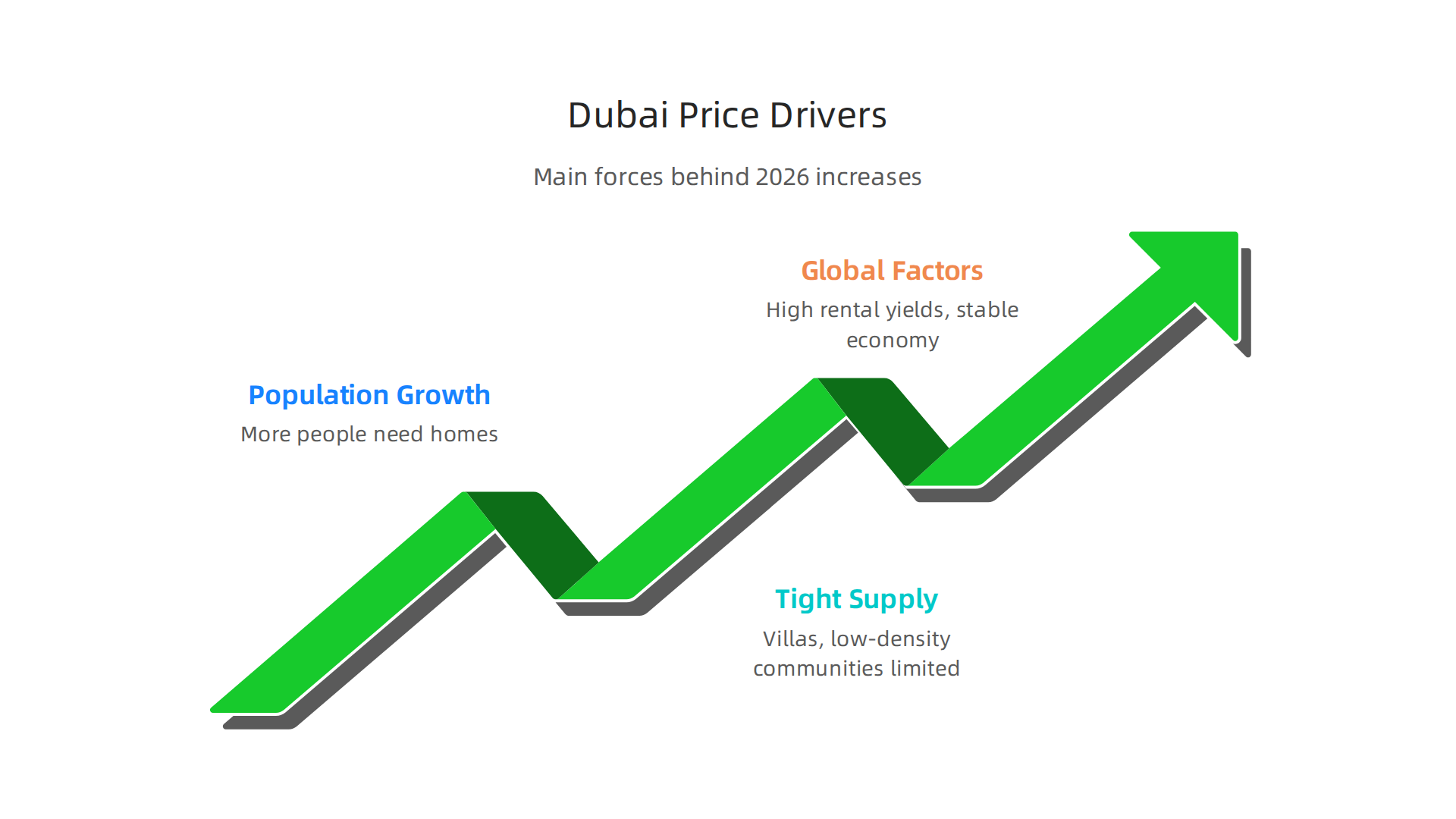
First, more people are moving to Dubai than ever before. The population keeps growing, and that means more people need homes. According to the Dubai Housing Market 2026 analysis, the IMF expects UAE economic growth of about 5% in 2026, which supports job creation and household wealth. More residents equals more demand for housing. Visa reforms also make it easier for investors and professionals to move here and stay long-term. That steady flow of new residents is a solid foundation for property values.
Second, supply is tighter than it looks. Even though you hear about new launches all the time, actual handovers are not flooding the market. Villas and low-density communities especially have limited supply. This helps keep prices from dropping. The 2026 analysis on Dubai real estate price declines notes that oversupply concerns are often community-specific rather than citywide. So in many popular areas, prices stay strong because there just aren’t enough homes to go around.
Third, global factors matter too. Interest rates and global economic conditions affect how buyers feel. But Dubai’s rental yields remain high by world standards, which keeps attracting international money. And the UAE’s stable economy and tax-friendly environment give investors confidence.
If you want to see how these drivers play out in specific communities, check out our step-by-step property search guide for Dubai in 2026. It helps you match the right area to the factors that matter most for your investment.
High Rental Yields and ROI: What Investors Can Expect in 2026
Now let’s talk about what really matters to most buyers in the uae property prices conversation: How much can you actually earn?
Dubai continues to offer some of the highest rental yields in the world. According to the detailed rental yield report for Dubai 2026, the average gross rental yield across the city sits at about 6.68% as of April 2026. That might not sound huge, but compare it to London or New York where yields usually sit between 2% and 4%. In Dubai, your money works harder.
Here is the breakdown by property type:
- Apartments average 7.15% gross rental yield
- Villas and townhouses average around 4.98%
Smaller units like studios and one-bedroom apartments perform best. In communities like Jumeirah Village Circle and Al Furjan, yields can reach 8% to 9% or even higher. For example, a studio in Al Furjan can deliver an average gross yield of 8.51% according to the same report. That is well above the city average and way above most global markets.
But here is the thing you need to understand. The gross yield is just the starting number. Your actual return on investment will be lower after you subtract service charges, maintenance fees, property management costs, and transaction fees like the Dubai Land Department registration fee of 4%. Experts estimate that net rental yields are typically about 1.5% to 2% lower than the gross figure. So a property with a 7% gross yield might give you around 5% to 5.5% in your pocket after all expenses.
Still, that is strong compared to almost any other major city. And when you add potential capital appreciation on top, the total ROI becomes even more attractive. The complete guide on how to buy property in Dubai walks through exactly how to calculate your true return including all costs.
The key takeaway for 2026 is this: Location and property type matter more than ever. If you are looking at the property uae market, focus on areas where rental demand is high and supply is limited. Apartments in well-connected communities tend to outperform villas when it comes to cash flow. But villas in established low-density areas can offer better long-term capital growth.
Whether your goal is monthly rental income or long-term appreciation, the best strategy starts with understanding the numbers. If you are ready to explore specific opportunities and want personalised guidance, you can connect with Ayaz Salman for a free consultation and get expert advice tailored to your investment goals.
Tax Advantages: Understanding Dubai’s Tax-Friendly Environment
One of the biggest reasons people choose to invest in the UAE is the tax setup. It’s simple, transparent, and very investor friendly.
Here is the truth: Dubai charges zero personal income tax, zero capital gains tax, and zero annual property tax.
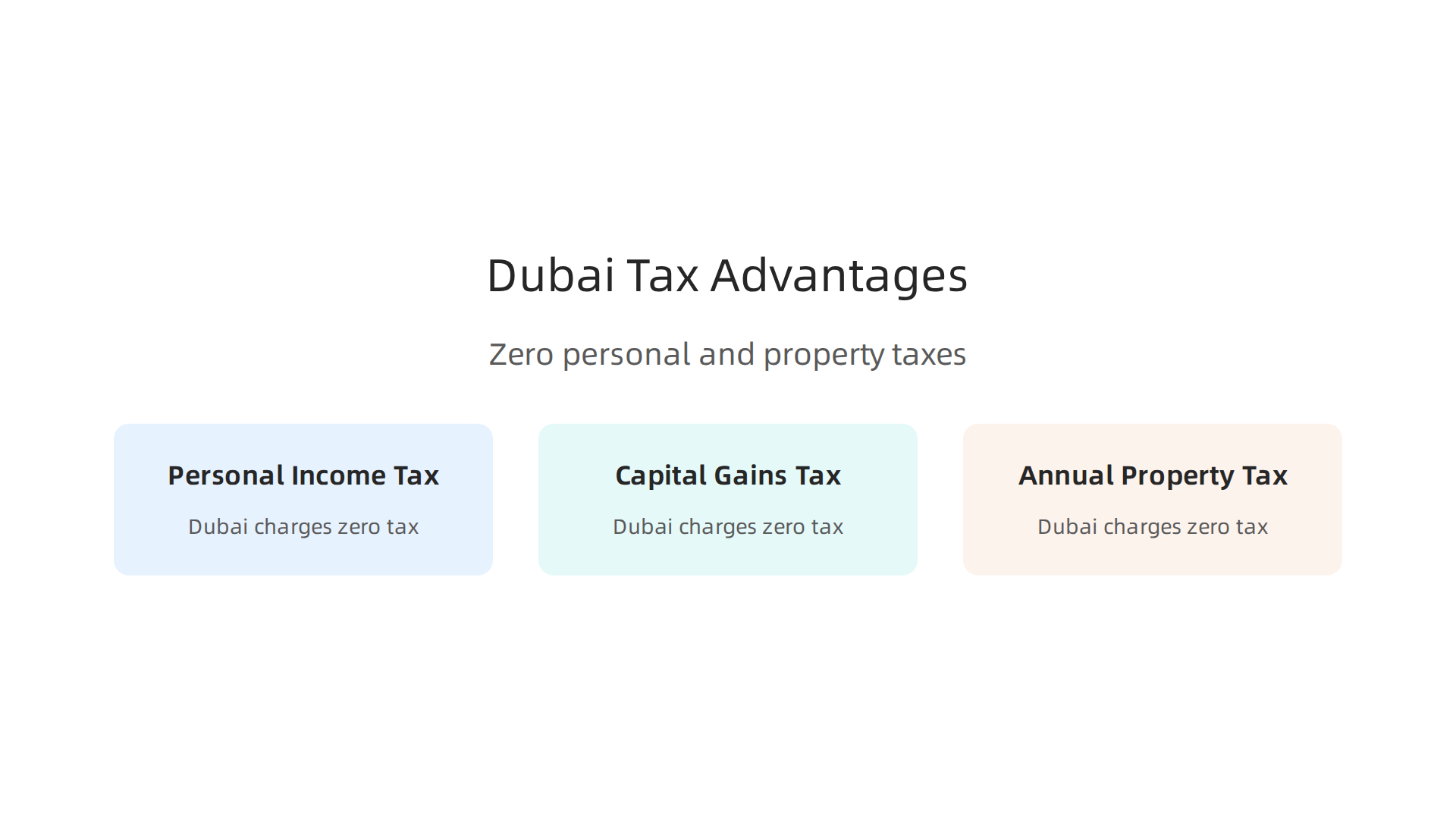
That is not a typo. You keep 100% of your rental income and 100% of any profit when you sell.
Many global cities hit you with yearly property taxes of 1% to 3% of the property value. In London, you can pay council tax plus stamp duty on top. In New York, property taxes eat into your returns every single year. In Dubai, there is none of that.
The only direct cost you pay to the government is a one-time 4% registration fee to the Dubai Land Department when you buy. After that, no recurring ownership tax. No tax on rental income. No capital gains tax when you sell. According to the property tax guide for Dubai, this low-tax framework is one of the main reasons the city pulls in global investors year after year.
For investors coming from high-tax countries, the difference adds up fast. Imagine earning AED 100,000 in rental income each year and keeping every dirham. In a place like the UK, you could lose 40% or more to taxes. In Dubai, you keep it all.
The same goes for capital gains. If your property doubles in value over ten years, the entire profit is yours. No tax bill waiting at the end.
This is a huge advantage when you compare uae property prices to markets in Europe, North America, or Asia. The 2026 guide to buying property in Dubai for tax-free yields and visa benefits walks you through exactly how these savings stack up over the long term.
If you are serious about keeping more of your returns and reducing your tax burden, Dubai offers one of the most favorable environments in the world for real estate investors.
Ready to take the next step? Get a free Dubai real estate consultation with Ayaz Salman to discuss how you can start investing tax-free today.
Legal Framework Simplified: Freehold, Visa, and Ownership Rights
Now that you see the tax benefits, let’s talk about the legal side. Many people worry that buying property in a foreign country is complicated. But Dubai makes it surprisingly simple for international buyers.
Here is the key fact: Foreign buyers can own freehold property in designated areas.

Freehold means you own the land and the building completely. You have full rights to sell it, lease it out, or live in it yourself. There are no restrictions on who you can sell to later.
These freehold zones include popular areas like Dubai Marina, Downtown Dubai, Palm Jumeirah, and Emirates Hills. When you buy in these areas, you get the same ownership rights as a UAE national.
This has made a huge difference in uae property prices over the years. As more foreign investors entered the market, demand grew and prices became more competitive globally.
Residency Through Property Ownership
Here is one of the biggest perks. If you buy a property worth AED 2 million or more, you qualify for a renewable residency visa. The standard investor visa is valid for 2 years and can be renewed as long as you keep the property.
And if you invest the same amount, you can also apply for the Golden Visa. That gives you a 10-year renewable residency. You can even sponsor your spouse, children, and parents. According to the tax advantages and visa benefits for foreign investors, this long-term stability is a major reason people choose Dubai.
This visa path alone makes it worth looking at property uae options if you want to live here part-time or full-time.
The Buying Process Step by Step
The actual process to buy is straightforward. Here is the basic flow:
- Find a property and agree on a price with the seller.
- Sign a Form F — this is the official sale agreement from the Dubai Land Department (DLD).
- Pay a deposit — usually 10% of the purchase price to secure the property.
- Get a No Objection Certificate (NOC) from the developer if buying a resale property.
- Transfer ownership at the DLD office.
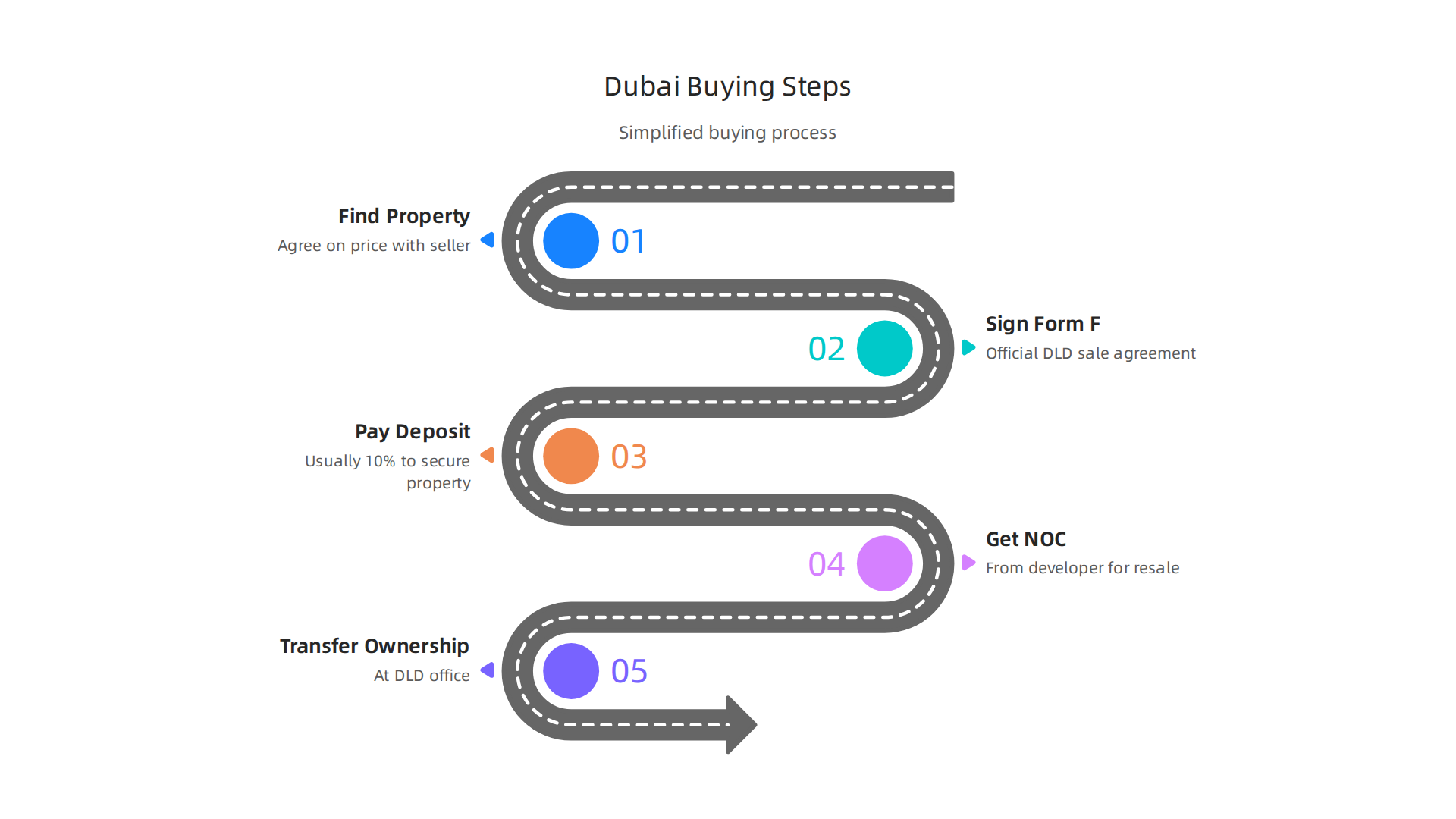
You pay the 4% registration fee and get the title deed in your name.
The whole thing can be done in a few days if you have all documents ready. You do not need a local partner or a special license.
Recent dubai real estate news often highlights how smooth and transparent this process is compared to other global markets. If you are also curious about the abu dhabi real estate market, similar freehold rules apply but with different designated zones.
For a complete walkthrough of each step, read our complete guide on how to buy property in Dubai for investors. It covers everything from finding a property to getting the keys.
What You Really Own
When you buy freehold in Dubai, you own the property forever. You can pass it to your heirs through a registered will. There is no inheritance tax, so your family keeps the full value.
So if you are ready to invest in dubai real estate, understanding the legal side gives you confidence. You are not just buying a home. You are buying full ownership, a pathway to residency, and a tax-free future.
If you want to start the process today, Ayaz Salman can help you step by step. Connect with Ayaz for a FREE Dubai Real Estate Consultation and get personalized advice on freehold areas, visa eligibility, and the buying process.
How to Identify Reputable Developers and Properties
Now that you understand the legal side, let’s talk about one of the most important parts of buying. How do you know if a developer is trustworthy? Not all developers are the same. Some have strong track records. Others have left buyers waiting for years. Here is how you tell the difference.
First, always check that the developer is registered with the Real Estate Regulatory Authority (RERA). This is the government body that oversees Dubai’s property market. If a developer is not registered, do not buy from them. You can search for any developer on the RERA website to see their license status. According to the Smart Buyer’s Checklist for Dubai property, you also need to make sure your payments go into a RERA-approved escrow account. This one step protects you from most common problems.
Next, look at the developer’s history. Have they delivered past projects on time? Do the finished buildings match the quality they promised? Search online for customer reviews and completion dates. A developer who has finished several projects on schedule is a safer choice than someone still building their first tower. The Off Plan Real Estate Dubai risks and rules guide recommends checking the status of past projects closely. This is where uae property prices stay stable over time. Developers with good reputations help keep value in their communities.
If you are buying off-plan, meaning the property is not built yet, you need extra caution. Always verify that an escrow account exists for the project. This account holds your money until the developer meets each construction milestone. The government watches these accounts closely. Never buy off-plan without seeing proof of a registered escrow account.
For a deeper look at this topic, read our guide on choosing the best property developers in Dubai. It covers the top names and what to watch for.
Staying up to date with dubai real estate news also helps you spot which developers are performing well. If you plan to invest in dubai real estate, picking a reliable developer is the most important first step.
When you are ready to move forward, you do not have to figure it out alone. Get a FREE Dubai Real Estate Consultation and receive personalized advice on developers, properties, and the full buying process.
Managing Your Investment from Overseas: Tips and Tools
So you have chosen a trustworthy developer and signed the papers. Now comes the next big question. How do you manage a property in Dubai when you live in another country? Many overseas investors worry about this.

But the good news is that the tools and services available today make it easier than ever.
The first thing you want to do is hire a licensed property management company. This is probably the smartest move you can make. These companies handle everything for you. They find tenants, collect rent, arrange repairs, and deal with any problems that come up. They also make sure your property stays in good condition. A good management company charges a fee, usually a small percentage of your rental income. That fee is worth every dirham when you consider the peace of mind it gives you. You do not have to worry about a midnight phone call about a broken pipe. The management team handles it.
Next, use digital tools to stay on top of your numbers. There are many apps and online dashboards designed for property investors. These tools let you track your rental income, see your expenses, and even view photos from inspections. You can check how your uae property prices are performing without ever leaving your home. Some apps connect directly to your bank account. This makes it easy to see when rent comes in and when bills go out. Staying organized this way helps you make better decisions about your investment.
You also need to think about tax residency and bank accounts. If you are a foreign investor, setting up a UAE bank account makes managing your money much smoother. Your management company can deposit rent directly into this account. Then you can transfer funds to your home country when you need to. Also, be aware of how your home country taxes foreign rental income. Some countries have tax treaties with the UAE. Understanding these rules early can save you surprises later. For a complete walkthrough of the whole process, check out our step-by-step guide on buying real estate in Dubai. It covers everything from start to finish.
For official information on property registration and ownership rules, you can visit the Dubai Land Department FAQ page.

It is a helpful resource for any investor.
When you are ready to get started or need help finding the right management team, you do not have to figure it out alone. Get a FREE Dubai Real Estate Consultation and get personalized advice on managing your property from overseas.
Summary
This article gives a practical, data-driven guide to buying property in Dubai in 2026, showing why the market remains attractive for investors. It summarises current price levels (average AED 3.05M, median AED 2.1M), neighbourhood performance, and forecasts such as ValuStrat’s 10% citywide growth and villas outperforming apartments. You’ll learn what drives prices—population inflow, constrained deliveries in low-density areas, and solid rental demand—and how new supply could affect specific segments. The piece explains expected rental yields (city average gross ~6.68%, apartments ~7.15%, villas ~4.98%), how to calculate net returns after fees, and the tax and visa benefits of UAE ownership. It also breaks down the legal freehold process, residency thresholds, how to vet developers (RERA, escrow accounts, delivery record), and practical tips for managing properties from overseas. After reading, you’ll know where to look, what numbers to run, which checks to make, and how to start the purchase process with confidence.