Dubai has become one of the top places in the world to buy luxury properties. High-net-worth individuals from every corner of the globe are turning their attention to this city. Why? Because buying luxury properties in Dubai comes with unique advantages that are hard to find anywhere else.
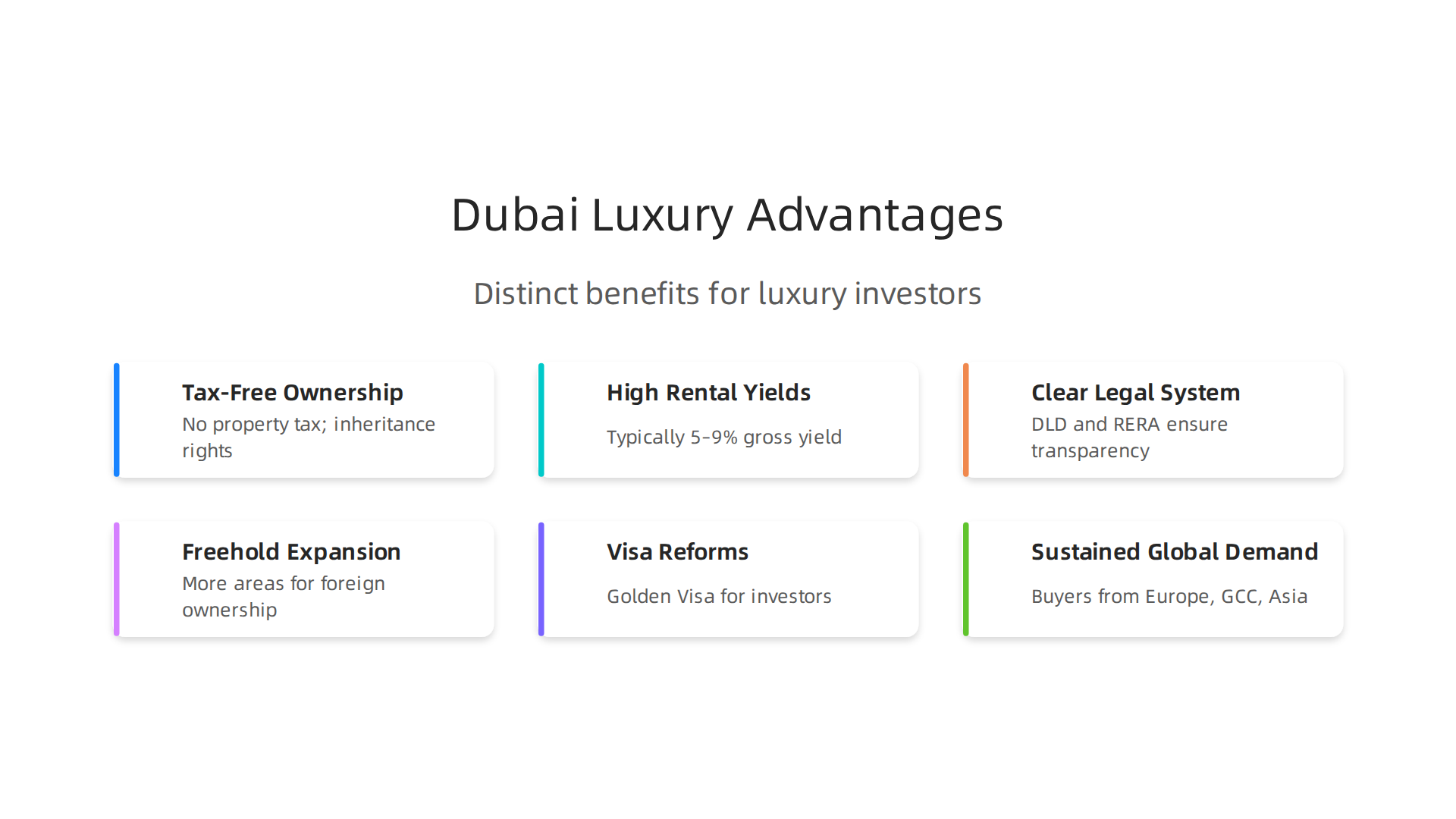
First, there is the tax-free ownership. You pay no property tax, no capital gains tax, and no inheritance tax. That means more money stays in your pocket. Second, rental yields are among the highest in the world. Investors often see returns of 5% to 8% or more in premium areas. Third, the legal system is clear and safe for foreign buyers. The Dubai Land Department and RERA make sure every transaction is transparent.
In 2026, the luxury market is stronger than ever. According to the Dubai luxury real estate market report Q1 2026, luxury transactions rose 23% year-on-year in the first quarter alone. Average prices in prime locations went up by 18%. Communities like Palm Jumeirah and Emirates Hills continue to lead the market.
This guide will give you research-backed information on the benefits, the legal steps, and the best strategies for investing in luxury property in Dubai 2026. Whether you want a home for your family or a high-performing asset, you will find useful insights here.
And if you are ready to take the next step, you can get a FREE Dubai Real Estate Consultation with Ayaz Salman. He can help you find the right property and guide you through the entire process.
But first, let’s look at why luxury homes for sale in Dubai are such a smart investment in 2026.
Dubai Luxury Real Estate Market: Resilience and Growth in 2026
The global economy has seen its share of ups and downs recently. Interest rates shifted. Geopolitical tensions flared. Yet the Dubai luxury real estate market barely blinked. In fact, it powered ahead with some of the strongest price growth and transaction volumes the city has ever recorded.
So what is driving this momentum? Three big things:
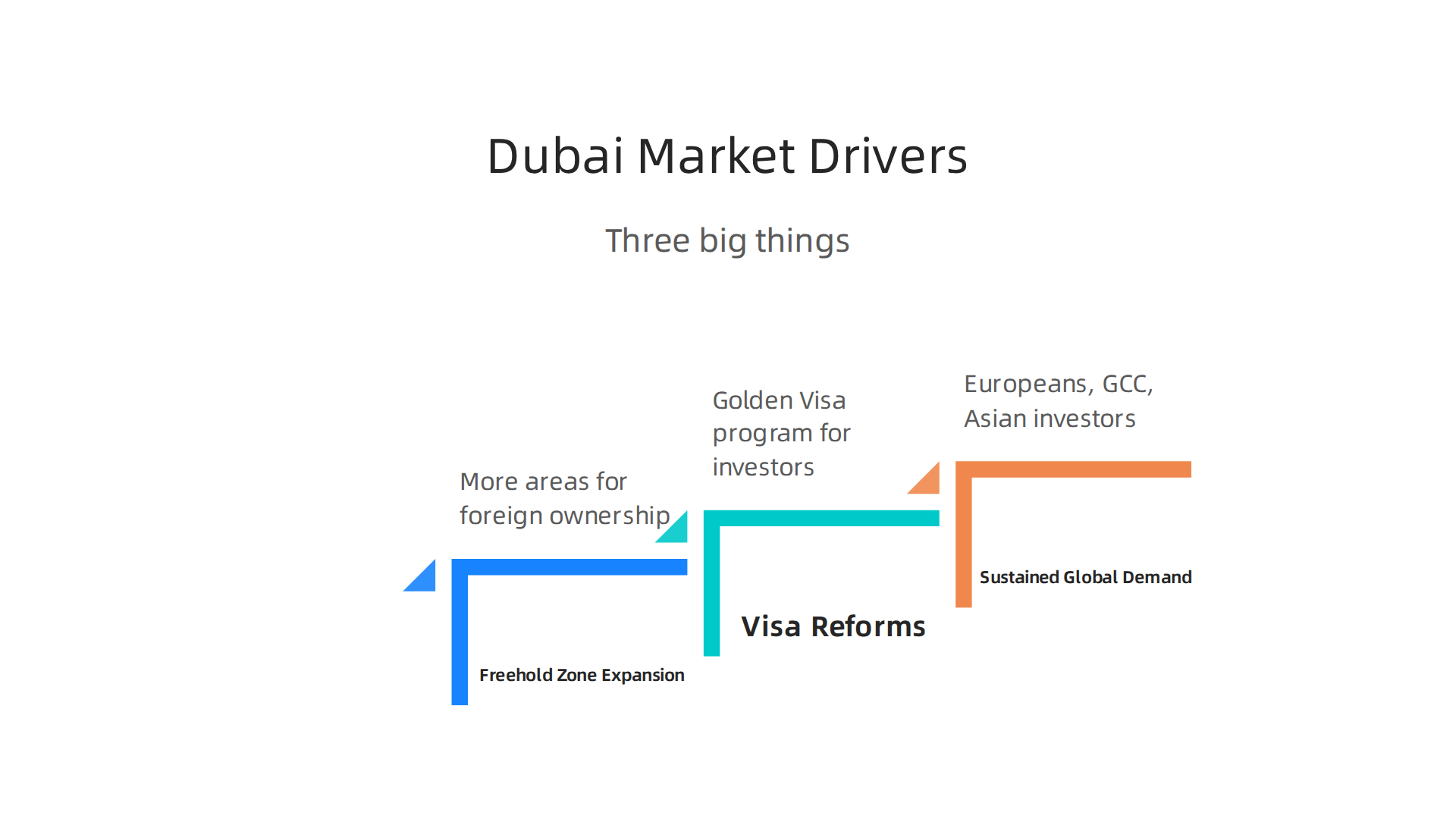
1. Freehold zone expansion. Dubai keeps opening more areas where foreign investors can own property outright. That makes more prime land available and keeps competition high.
2. Visa reforms. The Golden Visa program gives long-term residency to property investors. That is a game-changer for families and high-net-worth individuals who want stability in the region.
3. Sustained demand from global buyers. Europeans now make up 35 percent of luxury transactions. GCC nationals account for 25 percent. Asian investors are at 20 percent and climbing. The mix keeps the market balanced and strong.
The numbers back this up. The overall Dubai residential market saw average prices per square foot jump from about AED 872 in January 2020 to roughly AED 1,976 by early 2026. That is a 91 percent increase in just six years. Few major real estate markets in the world can match that trajectory. According to the Dubai Property Price Per Sqft 2026 Guide, the premium for villas over apartments is also widening, with villa prices reaching AED 2,376 per square foot compared to AED 1,871 for apartments.
The prime and ultra-luxury segments are where the action really heats up. Palm Jumeirah properties trade at close to AED 3,500 to 4,000 per square foot for apartments, and villa prices can exceed AED 6,000 per square foot for waterfront plots. Emirates Hills commands around AED 14,500 per square foot, putting it in the same league as London’s Mayfair or Monaco’s most exclusive addresses. Even Dubai Marina is seeing strong gains, with per-square-foot values rising by 19 percent year-on-year.
These are not just numbers on a page. They tell a story of real demand from real people who see Dubai as a safe haven with high returns. The market is supply-constrained at the top end, which keeps pushing prices upward.
If you are considering investing in this market, the key is choosing the right property in the right location. You can learn more about smart entry strategies in our guide to Dubai property investment 2026.
The resilience of luxury properties in Dubai is not a fluke. It is built on a foundation of smart government policies, strong international demand, and a lifestyle that attracts the world’s wealthiest people. And in 2026, that foundation is stronger than ever.
Legal Framework for Foreign Buyers: Freehold Zones and Ownership Structures
So you are excited about investing in Dubai’s luxury market. That makes sense. But before you hand over your money, you need to understand the legal side. The good news is that Dubai has built one of the most investor-friendly legal frameworks in the world for foreign buyers.
Here is the short version: you can own property outright in Dubai. But only in specific areas.
How freehold ownership works
Back in 2006, Dubai passed Law No. 7. This law gave non-UAE nationals the right to purchase freehold property in designated zones. Freehold means you own both the building and the land underneath it. You can sell it, lease it, or pass it on to your heirs. No expiry date. No restrictions on use. According to the 2026 guide to buying property in Dubai, freehold ownership grants perpetual rights that include inheritance privileges.
The list of approved freehold zones is long and growing. Some of the most popular include Downtown Dubai, Dubai Marina, Palm Jumeirah, Emirates Hills, Jumeirah Beach Residence, Arabian Ranches, and Business Bay. These are the same areas where luxury properties in Dubai command the highest prices and strongest rental returns.
If you are looking at luxury homes for sale in Dubai, chances are the property sits in one of these freehold zones. Always verify the registration type before you commit.
Who protects your investment
Two government bodies oversee every property transaction. The Dubai Land Department (DLD) handles registration, title deeds, and dispute resolution. The Real Estate Regulatory Authority (RERA) makes sure developers follow the rules.
When you buy an off-plan property, your money goes into an escrow account. The developer can only access those funds as construction progresses. This protects you from unfinished projects. It is a level of buyer protection that many global markets simply do not offer.
The costs you need to budget for
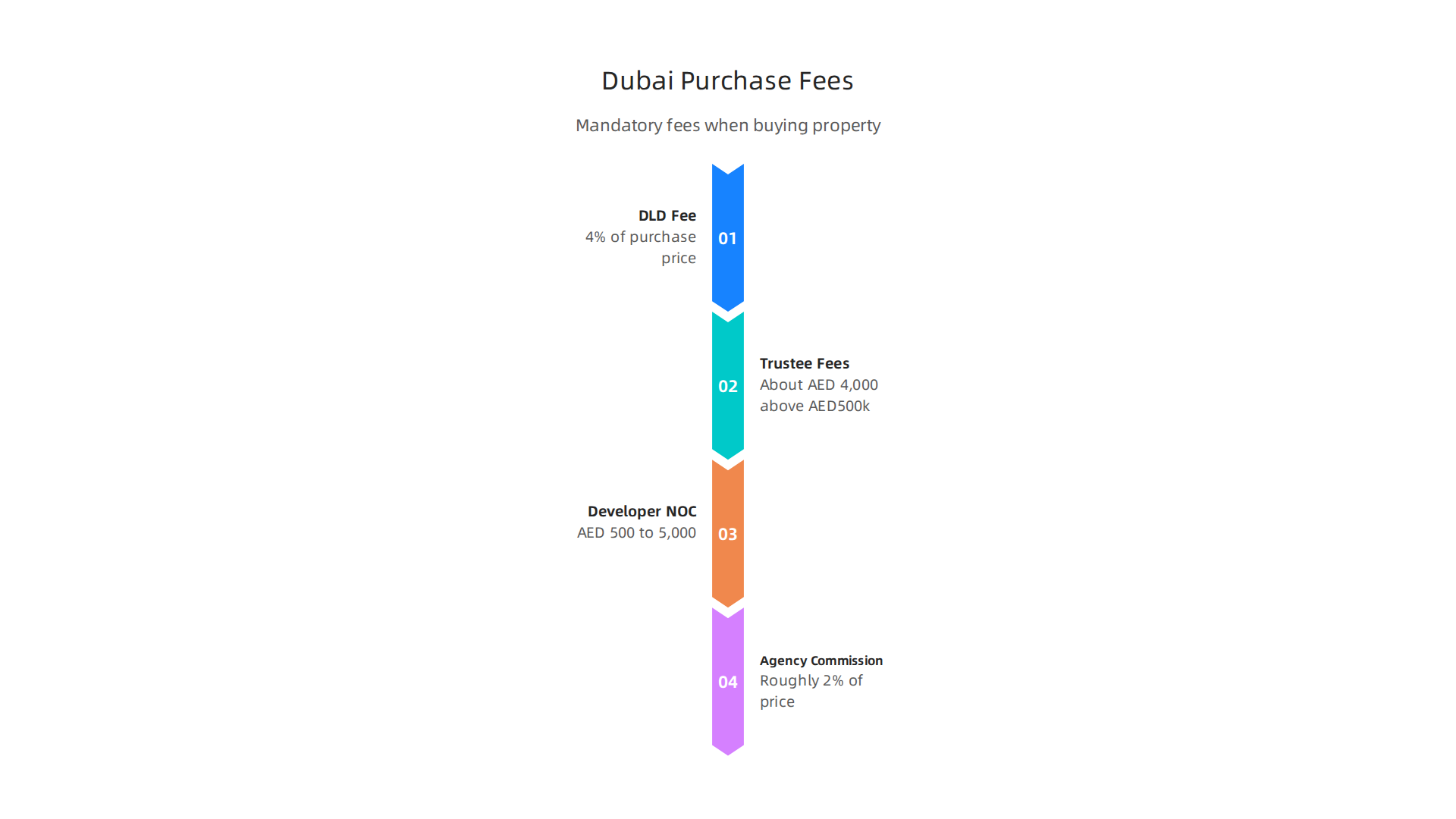
Every purchase comes with mandatory fees. The biggest is the DLD registration fee, which is 4 percent of the purchase price. You also need to pay trustee office fees of about AED 4,000 for properties above AED 500,000, an NOC fee from the developer ranging from AED 500 to 5,000, and agency commission of roughly 2 percent.
Here is the part that surprises most international buyers. Dubai has no annual property tax. No capital gains tax. No rental income tax. That is a massive advantage compared to cities like London or New York.
Visa eligibility through property ownership
As of 2026, the rules have changed. There is no longer a fixed AED 750,000 minimum for a two-year renewable investor visa. If you are the sole owner and meet eligibility criteria through the DLD Cube platform, you can qualify. For jointly owned properties, each investor needs at least AED 400,000. The Golden Visa still requires a AED 2 million investment and grants five or ten years of residency.
Understanding the full process is important. That is why we created a complete Dubai property buying guide that walks you through every step from search to handover.
If you want personalized guidance from someone who knows the market inside out, connect with Ayaz Salman for a FREE Dubai Real Estate Consultation. He can help you match your goals with the right property and ownership structure.
High Rental Yields and Capital Appreciation Potential
Now that you understand the legal setup, let’s look at the part that actually makes you money. Luxury properties Dubai deliver some of the highest returns in the world. And that is not just marketing talk. The numbers back it up.
Rental yields that beat London and New York
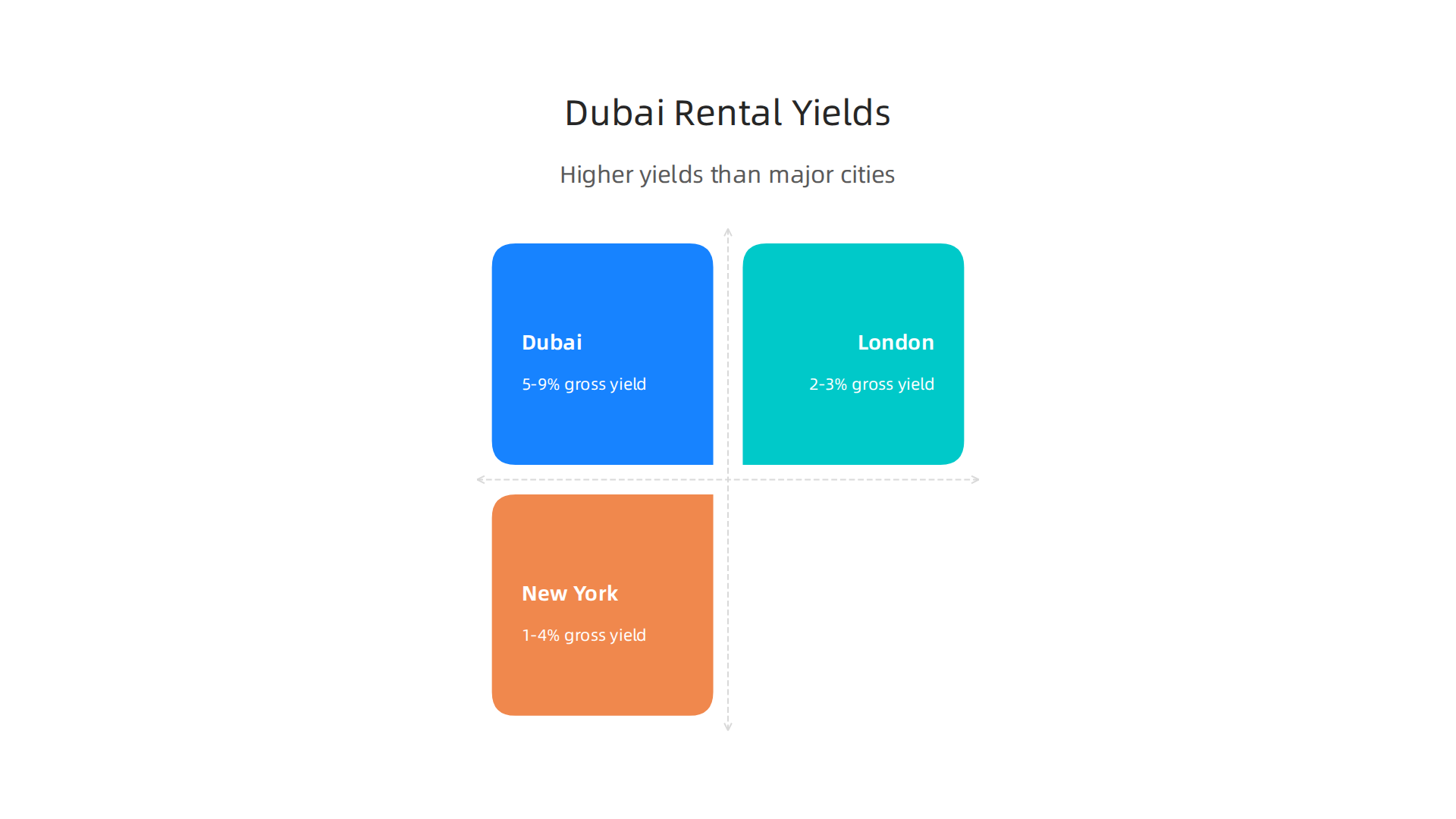
Here is the simple fact. Gross rental yields on luxury properties in Dubai typically range from 5 to 9 percent. Compare that to London at 2 to 3 percent or New York at 1 to 4 percent. The difference is huge.
The latest 2026 market data shows that apartments outperform villas. According to the Average Rental Yields in Dubai 2026 report, apartments across the city average 7.15 percent gross yield. Villas and townhouses average about 4.98 percent. But even the villa numbers are strong compared to global peers.
Where should you focus? Some communities stand out. Jumeirah Village Circle (JVC) offers yields around 7.43 percent for apartments. Downtown Dubai sits at 5.73 percent. Business Bay delivers 6.77 percent. And emerging areas like Dubai Sports City hit 8.23 percent. The Best rental yields in Dubai 2026 guide notes that studios and one-bedroom units often give the highest returns, sometimes reaching 8 to 10 percent.
Capital appreciation story
Rental income is only half the picture. Property values in prime districts have historically grown 10 to 15 percent per year. Why? Simple supply and demand. Dubai limits new construction in premium areas. At the same time, wealthy buyers and renters keep arriving.
Take Dubai Hills Estate as an example. A 2026 analysis shows that premium villas there saw rental premiums jump up to 35 percent year on year in 2025. Early 2026 shows more moderate but steady growth. For investors who bought off-plan a few years ago, the combined rental yield plus capital gain can easily cross 15 percent annually.
Tourism and global events keep the engine running. The Expo City legacy continues to bring business travelers and short term guests. That fuels both short term rental income and long term property values.
Why these numbers matter for your portfolio
If you invest in luxury properties in Dubai, you get two things at once: steady cash flow from high rental yields and long term wealth growth from appreciation.

Very few global cities offer this combination.
If you want to explore specific communities that match your return goals, check out our guide on Dubai real estate market 2026. It breaks down yields by area and property type.
The tax free environment multiplies every dollar you earn. No income tax on rent. No capital gains tax when you sell. So that 7 percent gross yield in Dubai is closer to 7 percent net. In a city with property taxes, you might see only 4 or 5 percent after costs. That is the real advantage.
Luxury properties in Dubai are not just about prestige. They are a numbers game. And the numbers are on your side.
Tax Advantages and Cost Efficiency of Dubai Property Ownership
But the numbers look even better when you factor in what Dubai does not take from you. If you are used to paying property tax every year in your home country, get ready for a pleasant shock. Dubai simply does not have one.
No property tax. No capital gains tax. No inheritance tax.
That is not a typo. It is the law. According to the 2026 guide on Dubai’s tax-free property ownership rules, Dubai charges zero annual property tax on residential real estate. When you sell your luxury property at a profit, you pay zero capital gains tax. And if you pass the property to your children, there is zero inheritance tax.
Compare that to London. In the UK, you might pay an annual council tax plus stamp duty on purchase. If you sell, you owe capital gains tax on the profit. In New York, property taxes can eat 1 to 2 percent of the home’s value every single year. Over ten years, that adds up to a huge chunk of your returns.
What you actually pay in Dubai
The only major upfront cost is the Dubai Land Department (DLD) transfer fee. That is 4 percent of the purchase price. You pay it once when you buy. After that, your recurring costs are mostly service charges for building maintenance and common areas. These are regulated and transparent. For luxury apartments, service charges typically run AED 10 to 50 per square foot per year depending on the building’s amenities. So a 1,500 square foot apartment might cost you AED 15,000 to 75,000 annually for upkeep. That is far less than property taxes in most Western cities.
Some investors also factor in a 5 percent municipality housing fee on the rental value. This appears on your DEWA (utility) bill each month if you rent the property. But if you live in the home or leave it empty, that fee does not apply.
The math on total cost of ownership
Let us do a quick comparison. Say you buy a 1.5 million dirham luxury apartment in Dubai. Your one-time DLD fee is 60,000 dirhams. Annual service charges might be 25,000 dirhams. That is your main cost. Compare that to a similar valued property in New York. Annual property taxes could easily be 30,000 dollars or more. Over five years, Dubai saves you over 150,000 dollars in taxes alone. That money stays in your pocket or gets reinvested.
This cost efficiency is why so many international investors see luxury properties in Dubai as a smart way to build wealth. You keep more of what you earn. Every rental dollar comes to you with zero tax deduction. Every gain when you sell is yours to keep.
If you want a deeper look at how this tax-free structure works with your personal situation, check out our full guide on buying property in Dubai for tax-free rental yields and visa benefits. It explains how the system protects your returns.
One more thing to consider
The UAE also offers the Golden Visa program for property buyers who invest at least 2 million dirhams. That gets you a renewable 5- or 10-year residency visa. Combine that with tax-free income, and you get a lifestyle and investment package that is hard to beat anywhere in the world.
So if you are thinking about luxury properties in Dubai, remember that what you do not pay in taxes is just as important as what you earn in rent and appreciation.

The low cost of ownership makes every percentage point of yield worth more.
Want to see how this works for your specific budget and goals? Reach out for a FREE Dubai Real Estate Consultation. No obligations, just straight talk about tax-free investing in Dubai.
Lifestyle, Community, and World-Class Amenities
The tax savings matter. But where you live matters just as much. Luxury properties in Dubai are not just about the financial returns. They are about how your everyday life feels from the moment you wake up.
Imagine stepping onto a private beach before breakfast. Or walking your dog along a marina with yachts and cafes. In Dubai, this is not a vacation. It is a Tuesday.
Master-planned communities that feel like resort towns
Many luxury homes for sale in Dubai sit inside master-planned communities. These are not random buildings on a street. They are neighborhoods designed from scratch with everything you need.
Communities like Dubai Hills Estate, Arabian Ranches, and Palm Jumeirah offer golf courses, parks, swimming pools, gyms, schools, and high-end retail all within walking distance. According to the 2026 investment case for Dubai villas and townhouses, these legacy communities already have complete infrastructure and strong tenant demand. Villa prices in Arabian Ranches rose 26.1 percent year on year in late 2025. That demand comes from people who want to live there, not just investors.
Newer communities like The Oasis by Emaar are taking things even further. They offer crystal lagoons, standalone villas, and private amenities that feel more like a five-star resort than a neighborhood.
Safety and infrastructure that quietly make life better
Dubai is one of the safest cities in the world. Violent crime is extremely rare. You can walk at midnight without worry. The roads are wide and clean. The metro and tram connect key areas. The healthcare system ranks among the best globally, with world-class hospitals and clinics.
For families, this is a huge relief. Kids can play outside. You can trust the quality of schools. Everything works reliably. That peace of mind is something you cannot put a price on.
A social calendar that never runs out
You will never be bored in Dubai. The city runs year-round events, from the Dubai Shopping Festival and Food Festival to art shows, concerts, and international sports tournaments. The cosmopolitan culture means you will meet people from over 200 nationalities. There is always something new to try, whether it is a pop-up restaurant, a desert safari, or a yacht party.
For retirees and professionals alike, the lifestyle here is hard to replicate anywhere else. You get the convenience of a modern city and the warmth of a community that welcomes everyone.
If you want to explore which luxury dubai properties match your lifestyle goals, check out our guide on luxury property in Dubai 2026. It breaks down the top branded residences and communities worth your attention.
Off-Plan vs. Ready Property: Which Luxury Investment Strategy Wins?
So you have decided to invest in luxury properties Dubai. But there is one big question left. Do you buy off-plan or a ready property?
The answer is not the same for everyone. Both paths can make you money. But they work differently. Your timeline, your risk comfort, and your need for cash flow will point you to the right choice.
Off-plan: Lower entry price, bigger upside potential
Off-plan means you buy a property before it is built. You pay based on a schedule, often over three to four years. The big draw is the price. You get in lower than the market value at completion.
In 2026, off-plan investing requires more caution than it did a few years ago. The market has matured. According to experts who analyzed the question "Is Off-Plan Property Still Worth It in 2026?", the most important factor now is developer reputation. Stick with established names like Emaar, Sobha, and Select Group. They have completed projects on time. You can walk through their finished buildings and see the quality.
If you choose wisely, the payoff can be big. Early buyers in some projects saw their units double in value by completion. Rental yields for those buyers often hit 8 to 10 percent. The second buyer who buys the same unit ready only gets around 4 percent.
Ready property: Certainty and immediate income
Ready properties are different. You can see exactly what you are getting. The finishes are not a promise. They are real. You can inspect the view, the light, and the noise level.
You also start earning from day one. If you want rental income now, this is your path. The average rental yield in Dubai in 2026 sits around 6.68 percent according to the latest rental yield market insights, with apartments outperforming villas. Some communities like JVC and Dubai Sports City offer even higher yields.
There is no construction risk. No delays. No surprises about final quality. For investors who need cash flow or who do not want to wait two to three years, ready is the straightforward play.
Which one fits you?
If you have patience and want the highest possible returns, go off-plan with a proven developer. If you want immediate income and certainty, buy ready.
Many smart investors do both. They buy a ready property for cash flow and an off-plan property for long-term appreciation. That way, they get the best of both worlds.
Not sure which path matches your goals? A professional can help you run the numbers. Reach out for a FREE Dubai Real Estate Consultation to talk through your options with someone who knows the market.
Summary
This article explains why luxury properties in Dubai are a compelling investment in 2026, covering market momentum, legal protections and practical buying strategies. It reviews strong price growth and transaction volumes, highlights high rental yields (typically 5–9% for luxury stock) and shows how freehold expansion and visa reforms support steady demand. The guide breaks down the legal framework for foreign buyers, mandatory fees (like the 4% DLD transfer) and escrow protections for off‑plan purchases, while comparing off‑plan versus ready properties for cash flow and appreciation. It also outlines Dubai’s tax advantages—no property, capital gains or inheritance tax—and explains typical ownership costs such as service charges and trustee fees. Finally, the article discusses lifestyle and community factors that sustain value and points readers to step‑by‑step buying guides and consultation options to match investment goals with the right property.